
Article: Where to Put Weights on Your Pickleball Paddle (And What Each Spot Actually Does)

Where to Put Weights on Your Pickleball Paddle (And What Each Spot Actually Does)
Adding weight to your paddle is one of the cheapest, fastest ways to change how it plays. A few grams in the right spot can give you more pop on drives, a steadier face on blocks, or quicker hands in a firefight.
A few grams in the wrong spot can do the opposite: a paddle that feels sluggish at the kitchen, late on counters, and tiring by the third game.
The difference is almost never how much weight you add. It's where you put it.
This guide breaks down every common placement, what it does to the way your paddle swings, and how to find the setup that fits your game.
First, the Three Numbers That Matter
Before you stick anything on your paddle, it helps to know what you're changing. Weight placement affects three things:
- Static weight — What the paddle weighs on a scale. This is the number on the label, and it's the least useful of the three. Two paddles that both weigh 8.0 oz can feel completely different in your hand.
- Swingweight — How heavy the paddle feels when you swing it. Weight that sits far from your hand (toward the tip) raises swingweight a lot. Weight close to your hand barely moves it. Higher swingweight means more plow-through and power; lower swingweight means faster hands. According to pickleball.com's swingweight breakdown, about 5 points of swingweight is the threshold most players can feel back to back, and 10 points is obvious to anyone.
- Twistweight — How well the paddle face resists rotating when you hit off center. Higher twistweight means a more forgiving sweet spot and more stable blocks and resets. Weight placed out at the edges of the face (3 and 9 o'clock) raises twistweight the most.
Every placement below is really a trade between those three.
The Paddle Clock: Every Weight Placement Explained
Picture your paddle face as a clock, with 12 o'clock at the tip and 6 o'clock at the throat where the face meets the handle.
12 O'Clock (The Tip): Maximum Power, Minimum Speed
What it does: Raises swingweight more than any other spot. You get more mass behind the ball on drives, serves, and overheads.
What it costs: Hand speed. Weight at the tip is the farthest possible point from your hand, so the paddle feels noticeably slower at the net. It also does very little for twistweight, so off-center hits still wobble.
Best for: Baseline bangers and players using a light, head-light paddle that feels like it has no plow-through.
Skip it if: You play a fast hands game at the kitchen or you already feel late on counters.
2 and 10 O'Clock (The Upper Corners): Power With a Bit of Stability
What it does: Splits the difference between the tip and the sides. You still add meaningful swingweight and power, plus a little twist resistance because the weight is out toward the edges.
What it costs: Still a real hit to hand speed. Tape at the top corners raises swingweight substantially.
Best for: Players who want more power and a little more forgiveness, and who aren't relying on hand battles to win points.
3 and 9 O'Clock (The Sides): Stability and a Bigger Sweet Spot
What it does: This is the twistweight spot. Weight on both edges at the midpoint of the face resists the paddle twisting on mishits, which makes the sweet spot feel bigger and blocks feel more solid.
What it costs: Some swingweight, depending on how much you add. A lot of weight here can also slow down wrist-roll motions like flicks and rolled volleys at the net.
Best for: Players who mishit a lot, get their paddle pushed around on hard drives, or want more consistency on resets.
Pro tip: Always add equal weight to both sides. Uneven side weight makes the paddle want to rotate one direction.
4 and 8 O'Clock (Lower Sides): The Safest Place to Start
What it does: Adds stability and a more solid feel while keeping most of your hand speed. Because the weight sits closer to your hand, swingweight goes up only slightly.
What it costs: Very little. You get less twistweight gain than at 3 and 9, but you give up much less speed.
Best for: Almost everyone trying weight for the first time. If you aren't sure where to begin, begin here.
6 O'Clock (The Throat): Solid Feel, Almost No Swingweight Change
What it does: Makes the paddle feel denser and more stable at contact while barely moving swingweight.
What it costs: You won't get much extra power or twist resistance here. It's a "feel" adjustment more than a performance overhaul.
Best for: Players who like how their paddle swings but want it to feel a little less hollow or buzzy.
The Handle and Butt Cap: Heavier Paddle, Faster Feel
This is the placement most players overlook, and it works differently from everything above.
What it does: Adding weight at the very end of the handle increases total mass and moves the balance point back toward your hand, all while adding almost nothing to swingweight. The paddle becomes more head-light. It feels quicker and more maneuverable, even though it now weighs more on a scale.
That extra mass still helps. A heavier paddle absorbs more of the impact from a hard-hit ball, so it gets pushed around less and sends less shock into your arm than an ultra-light setup.
What it costs: Handle weight won't add power at the tip or meaningfully raise twistweight on its own. It's a balance and feel adjustment.
Best for:
- Players whose paddle feels head-heavy or tiring to swing
- Anyone who added weight to the face and now feels slow at the net
- Players with elbow or forearm fatigue who want more mass without more swing effort
- Kitchen players who want fast hands and a stable, solid feel
Counterbalancing: The Setup Most Good Players End Up Using
Here's where it comes together. The most popular custom setups don't use one spot. They pair weight on the face with weight at the handle.
Add weight to the sides (say, 3 and 9 or 4 and 8 o'clock) and you get more stability and a bigger sweet spot. But that weight also raises swingweight and shifts the balance toward the head, which can make the paddle feel slow.
Add weight to the butt of the handle and you pull the balance point back toward your hand. The paddle keeps the stability from the side weight but feels quicker and less tiring to swing.
The result is a paddle that's heavier overall (more plow-through, less wobble, less arm shock) without feeling heavier in your hand.
The same idea works on its own, too. If your paddle feels head-heavy straight out of the wrapper, handle weight alone is often the fix.
Lead Tape vs. a Weighted Butt Cap
For the face and edges, lead or tungsten tape is the standard tool. It's cheap, easy to move, and easy to remove. Stick it under your edge guard to keep it hidden and protected.
For the handle, tape gets messy. You can wrap it under your grip, but it changes your grip size, shifts when you re-grip, and is hard to get perfectly even.
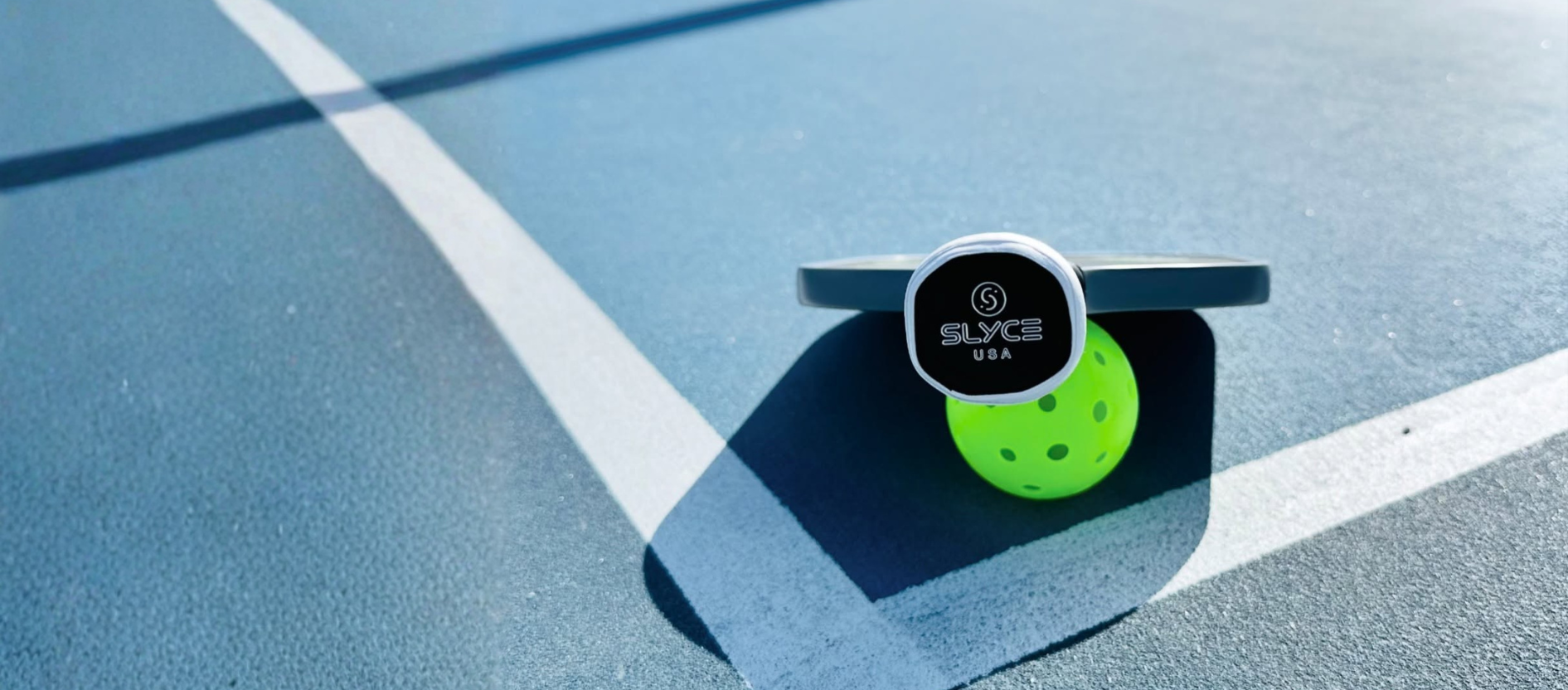
That's why we built the SLYCE SpeedCap. It replaces your paddle's stock butt cap with a precision-machined weighted cap, putting a fixed, exact amount of weight at the very end of the handle, where it moves your balance point the most. One clean install, the same feel every session, and nothing to peel off or reapply.
SpeedCaps come in a few weights so you can match how much you want to shift your balance:
- SpeedCap 28g (1.0 oz) — The biggest balance shift and the most added mass. Great for counterbalancing a paddle you've already weighted on the face.
- SpeedCap SLIM 18g — A lower-profile design for players who prefer a smaller, more traditional grip feel.
- SpeedCap 15g (1/2 oz) — A subtler change for players who want a little more stability without a big shift in feel.
Not Sure How Much Handle Weight You Want? Test It First.
Most players have no idea whether they'll prefer 15 grams at the handle or 28. That's the problem SLYCE SpeedCoins solve.
SpeedCoins are small, precision-machined solid brass discs, made in our Arizona workshop, that stick right onto most factory butt caps. They come in 5g, 10g, 15g, 20g, and 25g, so you can feel exactly what weight at the lowest point of your paddle does before you change anything permanently.
The process is simple:
- Stick a light SpeedCoin on your stock butt cap and play a session.
- Move up or down in weight until the paddle feels right in your hand and at the net.
- Once you've found your number, pick the SpeedCap that matches it.
One important note: SpeedCoins are a testing tool, not a tournament setup. Because they sit on top of your butt cap, they add length to your paddle and can push it past the allowed dimensions for sanctioned play. Use them to find your weight, then switch to a SpeedCap for competition.
Want a special look while you test? SpeedCoins also come in Special Edition Bodhi designs, like Bodhi Patriot.
Measure Your Balance Point
Want to see exactly where your balance point sits before and after? The SLYCE Billet Aluminum Precision Balancing Block gives you a solid, repeatable way to measure it.
How Much Weight Should You Add?
Less than you think, at least to start.
- Start small. A few grams on the face is enough to feel. Around 9 grams of added weight is noticeable to most players no matter where it goes.
- Change one thing at a time. If you add side weight and a butt cap on the same day, you won't know which one you like.
- Play real points. Hitting drives against a wall won't tell you how the paddle handles a hands battle. Give each setup at least a session or two of actual games.
- Go heavier, then trim. If you're experimenting with tape, it's easier to start a little heavy and cut strips down than to keep adding.
- Watch your arm. If your elbow or shoulder gets sore, pull weight off the tip first and move it toward the handle.
- Test handle weight before you buy. SpeedCoins let you try 5g to 25g at the butt cap in small steps, so you know which SpeedCap weight suits you.
Quick Setup Guide by Playing Style
| If you... | Try adding weight at... | Why |
|---|---|---|
| Want more power on drives and serves | 12 o'clock or 2 and 10 | Raises swingweight for more plow-through |
| Mishit a lot or get pushed around on blocks | 3 and 9 o'clock | Raises twistweight for a bigger sweet spot |
| Are trying weight for the first time | 4 and 8 o'clock | Adds stability with little speed loss |
| Want a more solid feel without changing swing | 6 o'clock (throat) | Barely affects swingweight |
| Feel slow or late at the kitchen | Handle / butt cap | Moves balance toward your hand |
| Added face weight and now feel sluggish | Handle / butt cap | Counterbalances the head weight |
| Deal with arm or elbow fatigue | Sides plus butt cap | More total mass without more swing effort |
| Don't know how much handle weight you like | SpeedCoins on your stock butt cap | Test 5g–25g before choosing a SpeedCap |
The Bottom Line
There is no single "best" place to put weight on a pickleball paddle. There's only the best place for your game.
- Tip weight buys power and costs speed.
- Side weight buys stability and forgiveness.
- Throat weight buys a solid feel.
- Handle weight buys a quicker, more balanced feel, and it's the easiest way to add mass without slowing your hands down.
Start small, change one thing at a time, and let real points tell you what works.
If your paddle feels heavy at the net, or you've added tape and lost your hand speed, a SLYCE SpeedCap is the simplest way to bring the balance back to your hand. Not sure which weight? Start with SpeedCoins and find your number first.
Frequently Asked Questions
Does adding weight to the handle make a paddle faster?
It makes the paddle feel faster. Handle weight adds total mass but moves the balance point toward your hand, so the paddle feels more head-light and maneuverable. It doesn't lower swingweight, but it adds almost none.
Where should I put lead tape for a bigger sweet spot?
At 3 and 9 o'clock, evenly on both sides. That placement raises twistweight the most, which helps the face stay stable on off-center hits.
Where should I put lead tape for more power?
At or near the tip (12 o'clock, or 2 and 10). Expect a trade-off in hand speed.
Can I use lead tape and a weighted butt cap together?
Yes, and it's one of the most popular setups. Face tape adds stability or power, and the butt cap counterbalances it so the paddle doesn't feel head-heavy.
Is adding weight to my paddle legal in tournaments?
Adding lead tape and edge guard weight is common among players at every level, including pros. If you play sanctioned events, check the current USA Pickleball paddle rules and your specific event's guidelines before competing with any modification. Note that SpeedCoins are designed for testing only. Because they sit on top of the butt cap, they can push your paddle past the allowed length and make it non-conforming for sanctioned play.
What's the difference between SpeedCoins and a SpeedCap?
SpeedCoins stick onto your existing butt cap so you can test different handle weights (5g to 25g) quickly. A SpeedCap replaces your stock butt cap entirely with a fixed-weight cap for a clean, permanent setup. Most players use SpeedCoins to find their weight, then install the matching SpeedCap.
How do I install a SpeedCap?
Remove your paddle's stock butt cap and install the SpeedCap in its place. Installation instructions and a video are available on each SpeedCap product page, and the SpeedCap Installation Kit includes a 2mm flat-blade screwdriver and athletic tape.

Written by Stephen Sorg