
Article: 6 Fast Hands Drills for Pickleball
6 Fast Hands Drills for Pickleball
Fast hands aren't a gift. They're trained. These six fast hands drills for pickleball take about 15 minutes. They cover the speed you need at the kitchen line: quick volleys, counters, and resets that land soft. Do them with your own paddle, add a little resistance, and you'll feel the difference the moment you take it off.
Why hand speed decides kitchen points
At the kitchen, you and your opponent are only about 14 feet apart. That's the two 7-foot non-volley zones put together. When a ball gets sped up at you from that distance, you don't have time to think. Your hands either get there or they don't.
Most players try to fix this by playing more games. But in a game you might only face a handful of real speed-ups. A drill gives you dozens in a few minutes. That's how quick hands get built: lots of reps, short and sharp.
Train with resistance, then take it off

Baseball players swing a weighted bat in the on-deck circle for the same reason. After working against extra weight, the normal bat feels lighter and quicker.
SLYCE Overload uses the same idea on the paddle you already play with. It clamps on in seconds and adds controlled resistance:
- 2 oz for speed: hand speed, reaction time, faster resets and high-tempo hand battles. Start here.
- 4 oz for strength: strength, stability, endurance and explosive paddle acceleration.
- Off to perform: take it off, and your game paddle feels lighter and quicker through the hitting zone.
Why not use a separate weighted training paddle? Because it has a different shape, grip and balance. Overload keeps the paddle your hands already know, so everything you train carries straight into your games.
The 6 fast hands drills
Do each drill in short, intense sets. Rest about 30 seconds between sets. Keep the paddle up and out in front the whole time.
1. Rapid-fire wall volleys (2 oz)
Stand about 6–8 feet from a wall. Volley the ball against it without letting it bounce. Do 3 sets of 30 seconds: one forehand-only, one backhand-only, and one switching every hit. Stay compact. The paddle should barely leave the space in front of your chest.
2. Kitchen hand battles (2 oz)
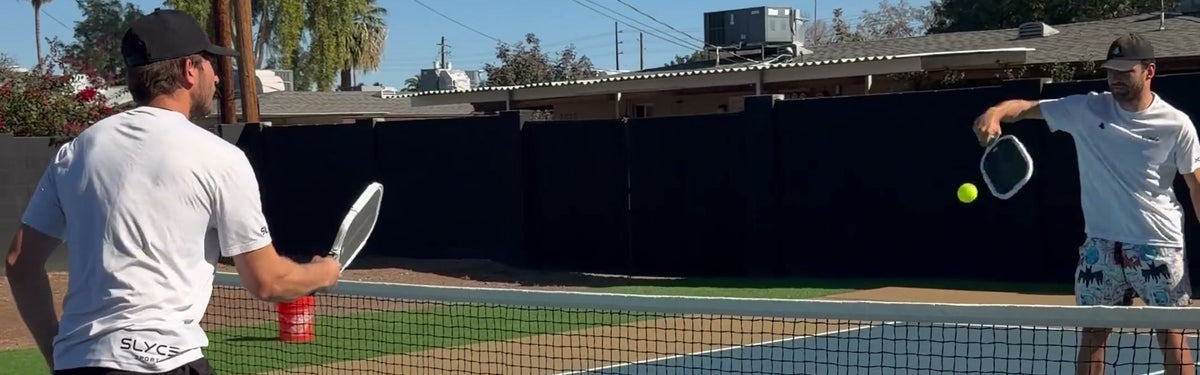
You and a partner stand at the kitchen line. Start with an easy volley exchange, then slowly raise the pace. Aim at each other's paddle side, not the body. Do 3 rallies of 45 seconds. The goal is to win the exchange with quick hands, not big swings.
3. Speed-up and counter (2 oz)
Your partner dinks to you, then speeds up a ball at your body without warning. You counter. Keep score: how many counters land in the court out of 10? Reset the count each round and try to beat your number. This trains you to react instead of guess.
4. Reset from the transition zone (2 oz)
Stand halfway between the baseline and the kitchen. Your partner drives balls at you from the kitchen. Block each one softly so it lands in the kitchen. Do 3 sets of 10. Resistance makes you use your legs and a firm wrist instead of a big arm swing. That's exactly what a good reset needs.
5. Shadow flicks (4 oz)
No ball needed. Get in your ready position and do quick forehand and backhand flicks, as if you're countering a speed-up. Do 3 sets of 20 per side. Heavier resistance builds the wrist and forearm strength behind a fast, stable paddle. Stop if you feel sharp pain in your wrist or elbow.
6. Contrast set (on, then off)
Finish every session with this. Do 30 seconds of wall volleys with Overload on. Take it off right away and do 30 seconds more. Repeat 3 times. The paddle will feel noticeably lighter and quicker. That's the feeling you take into your next game.
A simple 15-minute routine
| Block | Drill | Resistance | Time |
|---|---|---|---|
| Warm-up | Wall volleys, easy pace | Off | 2 min |
| Speed | Drills 1–3 | 2 oz | 7 min |
| Control | Drill 4 | 2 oz | 2 min |
| Strength | Drill 5 | 4 oz | 2 min |
| Finish | Drill 6, contrast set | On, then off | 2 min |
Do this 2–3 times a week, before you play or on off days. New to resistance training? Stay with 2 oz for the first couple of weeks before adding 4 oz.
Pair Overload with the right paddle setup
Training builds faster hands. Your paddle setup decides how quick it feels in a match. Overload is for training only, so you take it off before you play. SLYCE SpeedCap is different: it stays on the paddle for games. It adds weight at the handle, which makes the head feel lighter and quicker in your hand. To see how weight in different spots changes your paddle, read Where to Put Weights on Your Pickleball Paddle.
Start with 2 oz
Want quicker hands at the kitchen this season? Start with the 2 oz Overload, run the 15-minute routine three times a week, and finish every session with the contrast set.
Available in 2 oz ($54), 4 oz ($59), or both for progressive training ($99).
Train heavy. Play fast. It's your game.™